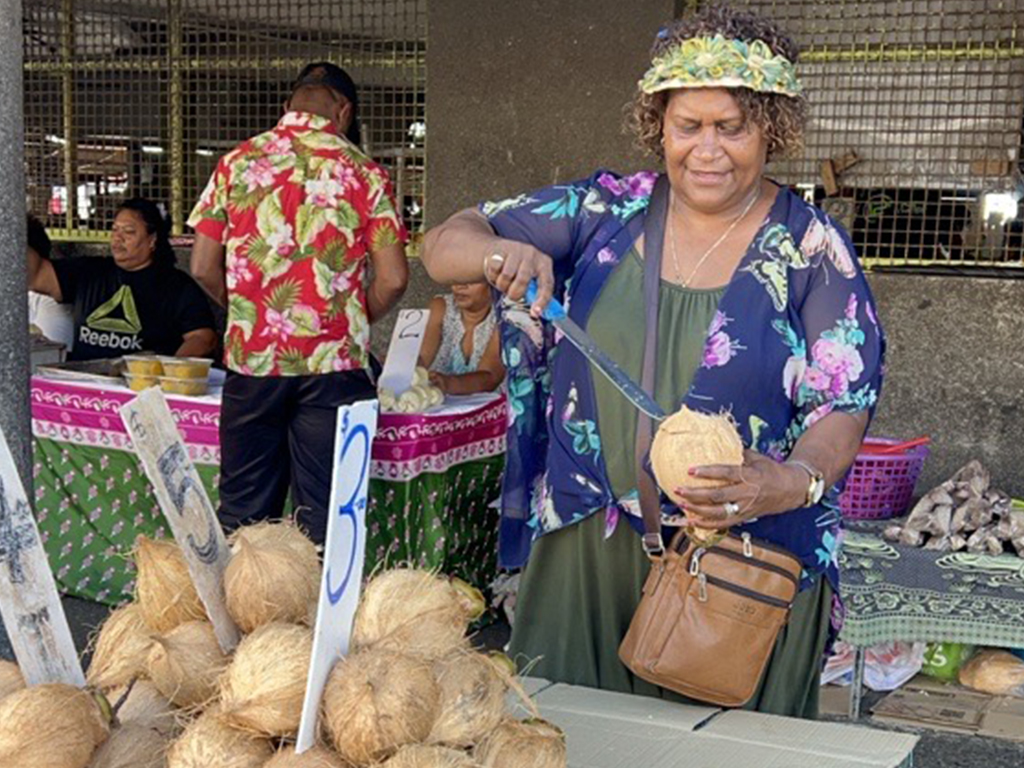
For nearly a decade, 51-year-old Imeri Marama has built her livelihood one day at a time.
A single mother and full-time market vendor, Imeri made the bold decision over ten years ago to leave formal employment and focus entirely on her market business. While many questioned the move, she saw something others did not, a daily income, flexibility, and control over her future.
As a Suva City based market vendor, Imeri did not just sell produce, she invested in herself. Through the years, she actively participated in market vendor workshops, where financial literacy became a turning point. Learning the importance of budgeting, saving, and investing transformed how she managed her earnings.
That knowledge ignited a long-held dream: owning a car.
For Imeri, a car was not a luxury. It was a business tool. Every day, she spent nearly $20 on taxi fares, transporting goods between her home in Tacirua and the market. Eventually, she realised that her taxi fare expenses could be redirected towards something far more powerful and that was ownership.
Imeri’s journey to car ownership did not happen instantly. She started by applying for her driver’s licence and once approved, she began exploring financing options.
Like many informal workers, Imeri found that certain financial institutions often overlooked market vendors due to the lack of payslips or formal employment records. But everything changed when she walked into Merchant Finance and visited our Marama Finance team.
Instead of turning her away, the Marama Finance team took the time to understand her reality. They guided her through what was required, helped her strengthen her financial records, and supported her in improving how she tracked her income and savings.
In addition to the support, Imeri took on her own initiative and went a step further. She opened three separate bank accounts, dedicated to different savings goals, and tapped into additional financial awareness programmes to improve how she made deposits and maintained statements.
Today, Imeri runs a single stall selling fresh coconut water, cooked dalo, and cassava, a business that consistently sells out. With her sights set on the future, she now plans to expand her business in 2026 by opening a second stall supplied with root crops from her village in Sigatoka.
But even before that, in 2025, her months of disciplined saving, proper financial tracking, and steady income led her to achieve what many once thought was impossible.
She bought her first-ever dream car through the assistance and support of the Marama Finance team and financing from Merchant Finance Limited.
Now, she makes two trips a day: delivering her morning batch of goods, then heading home at lunchtime to prepare for the afternoon rush. What once was a challenge in terms of taxi, costs and time is now replaced by independence, comfort and efficiency.
When Imeri drove her car to the Suva market for the very first time, disbelief followed.
“People didn’t believe it was mine,” she says. “There is this idea that market vendors, especially single mum market vendors, cannot own something like this.”
But that perception is changing.
Today, fellow vendors regularly approach Imeri, asking how they too can achieve the same and own their dream car. She now mentors three other women vendors, helping them improve their bookkeeping, financial tracking, and savings, paying forward the knowledge she gained.
Her leadership extends beyond her own success. Imeri is also the Secretary of the Suva Market Inspiring Women’s Cooperative, a group of women vendors working together to build a shared future. The cooperative is currently planning to open a restaurant and a bakery, both fully owned by the women members themselves.
For Imeri, her proudest moment isn’t just owning a car, it is redefining success.
“People look down on market vendors,” she reflects. “But I earn every day. I am my own boss. I earn good money and I support my family. That makes me proud.”
A message to other Women
Imeri’s advice is simple and powerful:
“Learn to save, invest in things that help you grow and don’t be afraid to ask for help.”
Today, her journey stands as proof that women in informal sectors are more than capable of building assets, growing businesses, and inspiring communities.